Showing posts with label Junereads. Show all posts

Friday, June 16, 2017

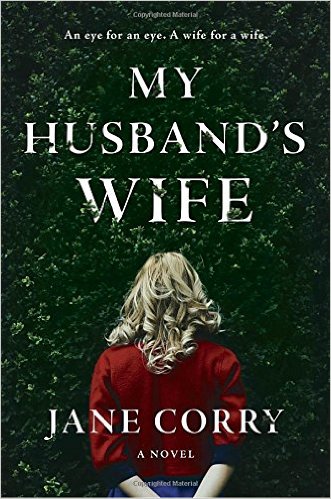
My Husband's Wife by Jane Corry (Spoiler Alert)

My Husband's Wife is a book that kind of jumped out at me. I was in the bookstore one day waiting for my husband, saw it on the shelf and was so intrigued that I began reading it. I only read the first seven pages or so, but it was a book that stayed in my mind. Last week I was at Target and was pleasantly surprised to find it in their book section. I was in need of a new book so I picked it up and proceeded to read it in just two days.

Image from Amazon.com
Jane Corry does an excellent job of writing a thriller that isn't too terrifying. What I mean is that the novel keeps you on the edge of your seat but does not keep you up at night afraid that what is happening in the book will happen to you. In a word, it is my kind of thriller. The novel is told by two characters, Lily and Carla. From a writing perspective I thought it was interesting because Lily's sections are written in first person, but Carla's are written in third person limited (if I am remembering my terms correctly). So as a reader I always felt more connected to Lily and her well-being. This was an interesting clue in hindsight because at the end of the novel I was definitely left hating Carla and seeing her as the villain.

My Husband's Wife is a novel that does not have one main villain though. There is Carla of course, but also the character of Joe Thomas who is in fact a murderer. Lily is the lawyer that helps him make his appeal that ultimately sets him free, only to learn later that Joe was indeed guilty. Joe becomes involved in Lily's life, much against her will, and is a part of the entire novel. There is also the character of Ed, Lily's husband. Ed is someone who starts the novel out telling lies. He is an artist with an alcohol problem and eventually he leaves Lily for Carla. There are so many things that, while they don't make him the biggest villain, do make him guilty. His eventual murder is not a surprise because the book begins by letting the reader know this happens, but the murder(ers) themselves are surprising. And then there is Lily. She, like her husband, is not the biggest villain, however she is a key part of so many events. Not only that, but she does not fulfill her moral obligation to tell the police about Joe and in some ways encourages his behavior. Throughout the novel she does many questionable things and even though she is not necessarily punished in the end, I was left feeling like she was so much more a villain than a victim.

Overall, I greatly enjoyed this novel. My Husband's Wife really spoke to the philosopher in me with all of its questions of morality and what it means to be marriedthe best thriller I have read, Gone Girl still has that spot, but it was definitely up there. For those that enjoy mysteries or thrillers, especially ones that make you think, this is a book for you.
. It was also immensely interesting and kept me turning the pages until it was finished. It was not

Friday, June 9, 2017

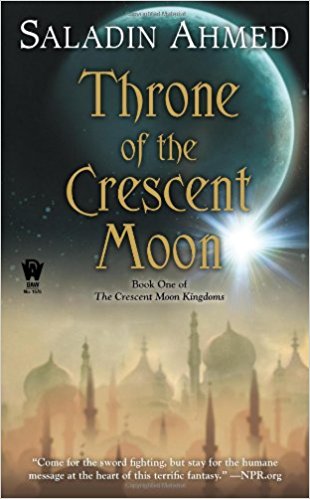
Update and Review of Throne of the Crescent Moon by Saladin Ahmed

 Hi! I'm back! I apologize for the long, unexplained hiatus. It was unplanned but came about because I had not really been reading recently. I know, shocking, but my mind has been so wrapped up in other things that I could hardly focus on anything, let alone reading. I found out back in April that I was pregnant again. While this news was welcome and joyful it was also frightening given my history. I am finally getting past the scary points and have been delving into books again. Until December when my little one arrives, I should be posting regularly once more. The first book I picked back up was Throne of the Crescent Moon.

Image from Amazon
I had heard of Throne of the Crescent Moon quite a few years ago. It was always a book I was interested in but never picked up when I ran to the bookstore. Then my husband and I attended Phoenix Comic Con a couple of weeks ago and the author Scott Lynch mentioned the novel. I felt like fantasy would be a good genre to pull me back into reading and so I went to the bookstore a few days later and finally bought Throne of the Crescent Moon.

This novel moved very quickly, which I enjoyed. There was a lot of action but it was not overly descriptive. The magic systems in the book were not explained in full and I think that helped lend the book it's pace. Sometimes I feel if magic is laid out rule by rule I lose interest. Saladin Ahmed did a perfect job of explaining just enough for me to want to know more but not enough to bore me. His magic systems were unique. There were religious aspects and elemental aspects that gave the magic a very ancient vibe. The book in and of itself had religious undertones but they were not "in your face" so to speak.  Throne of the Crescent Moon is very aware of itself.

I did feel as though the book ended a bit too easily and am curious to see what the sequel will bring. But I loved that there was a happy ending for the main character of Dr. Adoulla. Aside from him, my favorite characters were probably Zamia and Litaz. They are female characters that are strong and also kick some serious butt. I am hoping there is more about them in the upcoming novels, as this is meant to be the beginning of a trilogy.

Overall, this was a book I devoured and enjoyed. I would recommend it to anyone who enjoys fantasy of any kind. If the other books were out I would already be diving into them. I am sorry again for the hiatus. And also sorry for the brevity of this post, pregnancy brain is a real thing. Happy reading!

Friday, July 1, 2016

The View From the Cheap Seats by Neil Gaiman

Neil Gaiman is my favorite author. He is also one of my favorite people, just in general. If you want an example of why, just watch this. He is an inspiration and also a creative powerhouse. This man is so prolific that he has done almost everything (and continues to): comics, books of all kinds, movies, tv shows, you name it. So for an aspiring writer he is basically the equivalent to Beyonce. (Although I do also love Beyonce.) I had the chance to meet him 4 years ago and that moment changed my life. (I cried, he shook my hand, it was a good moment.) I am going to see his "An Evening With Neil Gaiman" show next April. But I digress....at another time I will write a big gushy post about Neil Gaiman. Today I am going to stick to my thoughts on his recent book release, the nonfiction collection The View From the Cheap Seats.

Anything by Mr. Gaiman makes me a very happy reader. I bought this book the day it came out and began reading it right away but made myself take all of June to finish it because I liked knowing I had fresh Neil things to read sitting in my room. I was initially worried though because it was a book of nonfiction. I like nonfiction, but even the best of us have to admit it can be boring sometimes. I was pleasantly surprised to find that nothing in this book was boring, not even the introductions to books that were, obviously, not included.

The book is split up into ten sections and within each section are articles or speeches or introductions that fall within the category of that section. I was very happy that his Make Good Art speech had its own section and was the only piece included there. Neil managed to make me scared with his articles and introductions to Edgar Allan Poe or Dracula. He made me cry with a few articles about Amanda Palmer and Anthony Martignetti and Syria. He made me smile and laugh and nod my head in agreement with so many of his other pieces. In the end I felt happy and whole. I now have a list of books, authors, comics, films and artists to look up and enjoy. Surprisingly, The View From the Cheap Seats has become one of my top favorite Neil Gaiman books.

I do not necessarily recommend it for someone who wants to get into reading Neil Gaiman, but I would recommend it to someone who enjoys his work or has at least read one of his fiction novels. But even if one has not read a Neil Gaiman book and wants to go against my advice, one would still enjoy this book. It is full of wisdom and wit and love and wonder. It is, assuredly, a Neil Gaiman book.

I want to finish this review with a list of some of my favorite pieces from The View From the Cheap Seats. I read the book in order, but it certainly does not have to be read that way, so if you want to just peruse a few pieces listed below are my favorites:

- "Why Our Future Depends on Libraries, Reading and Daydreaming", page 5
- "Telling Lies for a Living...and Why We Do It", page 16
- "The Pornography of Genre, or the Genre of Pornography", page 39
- "What the [Very Bad Swearword] Is a Children's Book, Anyway?, page 77
- "Harlan Ellison: The Beast That Shouted Love at the Heart of the World", page 117
- "SIMCITY", page 154
- "Ray Bradbury, Fahrenheit 451, and what Science Fiction is and Does", page 177
- "2004 Harvey Awards Speech", page 300
- "Some Strangeness in the Proportion: The Exquisite Beauties of Edgar Allan Poe", page 317
- "Hi, by the Way: Tori Amos", page 389
- "Once Upon a Time", page 423
- "Make Good Art", page 451
- "The View From the Cheap Seats", page 463
- "The Dresden Dolls: Hallowe'en 2010", page 470
Tuesday, June 28, 2016

The Great Gatsby by F. Scott Fitzgerald (Spoiler, it is actually a horror story)

I first read The Great Gatsby when I was 15 for school. I did not think I would find such a book entertaining. Although I liked classics, I preferred Jane Austen, and this did not sound close to that type of novel. I was surprised to not only be captivated so much by the story but to finish it all in one sitting. The story of a man so in love with a woman who, while she loved him, was ultimately quite selfish fascinated me. And the unexpected, tragic ending made the story all the more interesting and memorable.  A couple of years later when I was 17 my family moved and the school I was enrolled in happened to read Gatsby during Junior year. So for the second time in my life, also for school, I read the novel. The course work focused more on details, especially the use of color, throughout the novel and I was able to see the work in a more academic light. I understood more deeply how wonderful of a novelist Fitzgerald was. The Great Gatsby became one of my favorite books. It was in that class I watched my first film version, the 2000 version with Paul Rudd as Nick Carraway. While I did not love the movie, it was interesting to see a book come to life in such a perfect way on film, as this so rarely happens. But the story seemed to translate well, even if it could have been an aesthetically better film.  Luckily, a better film was made only a few years later.

When I was 19, the Baz Luhrmann directed version of the film was released. My favorite actress played Daisy, Leo DiCaprio played Gatsby, Tobey McGuire played Nick (which is perfect because I dislike Nick as a character and Tobey is not a favorite actor of mine). Overall the casting was spot on. Luhrmann was a wonderful choice to direct such a huge film, especially the party scenes. My only concern was that Jay-Z was in charge of the music, and all of it was modern. I reread the novel before the film came out and again was swept into the romance of Gatsby and Daisy. When I saw the film I was even more in love. The soundtrack was actually perfect. It allowed for modern audiences to ground themselves in the 1920s and really feel the energy of that time. Party music from the 20s probably would not evoke the same feeling now, but party music from now over scenes from the 20s would. I cannot speak highly enough of this film. But I have digressed....

Over the weekend I reread The Great Gatsby much like I had the first time, all in one sitting. I chose it as my "book that takes place during summer" for mine and my husband's reading challenge. It has been three years since the last time I read the novel. A lot has happened in my life since then and I was surprised to see how the shape of this story changed through my new eyes. But I realized that while The Great Gatsby may be a good novel about class differences and nouveau riche and old, and it may be a good love story, and a good example of that time period; The Great Gatsby is actually a horror story. 

Let me explain: The first time one reads this novel, you are swept up in the parties and love story, so when Gatsby dies you are sad but that is all. The following times you might focus on the love story, and still be saddened by the end, but perhaps hoping this time Gatsby will live. However, reading it now and knowing Gatsby dies, and there is nothing I can do to save him, I was dreading the end the entire time. As I read each scene where there was a party it just seemed like an overly obvious way to cover up the horrific tragedy of the finale. The lies Gatsby tells, the rumors that swirl about his shady past and identity, all of these suddenly were screaming clues that the inevitable end of this novel was Gatsby's death. Gatsby in and of himself seemed haunted by his love of Daisy. Reading it this time I saw him as nothing more than a ghost, a man already dead whose last chance at life was Daisy's requited love. I realized that even if he was not unfairly shot by Wilson, who was under the incorrect impression that Gatsby was his wife's lover, the end of the novel would probably still have culminated in Gatsby's suicide. 

This time around I noticed more sentences that spoke about the American way of life and commented on society and the human condition. I don't know how they escaped me in the past but suddenly I was reading a novel with great depth of thought, not just plot. A novel full of the depravity of life and the emptiness of hot summer days and money. Gatsby never belonged in that world and yet there he was. I am still processing this new realization. I am sure my next read of this novel, because I know it is one I will revisit often in my life, will provide even further insight to this new concept. For now know that The Great Gatsby is a wonderful novel. If you have not read it, go do so now (and I apologize for putting ideas in your head beforehand, it is a novel read best when you know nothing about it); if you have read it, go reread it and let me know how it has changed for you. Do you dread the party scenes as much as I? 

"They were careless people, Tom and Daisy- they smashed up things and creatures and then retreated back into their money or their vast carelessness, or whatever it was that kept them together, and let other people clean up the mess they had made..."

Saturday, June 25, 2016

Fahrenheit 451 by Ray Bradbury

I am ashamed to say that until now I have read nothing by Ray Bradbury. But I am proud to say this was my first Bradbury novel.

I read Fahrenheit 451 in two sittings, one small burst and one long one. Both times I had to take a nap. I don't know if the napping is related, but the book does have a heaviness to it. A lingering panic that creeps around the edges of the plot and exhausts you. I was happy to have finished the book but I was not happy because of the book. In fact this novel left me feeling quite depressed. I was depressed because so many elements of Bradbury's world mirror our own, because even though this cautionary tale is over 60 years old I see a similar pattern, and most of all I was depressed because no one had ever made me read this book. And yet I felt like this should be required reading. (I know in most places it is but it never was for me, sadly).

The main character of Guy Montag is not exactly likeable. I am still not sure whether Bradbury intended for the reader to like Montag or not or if it even mattered. What mattered was that Montag moved the plot along wonderfully.  This is not a novel you read for the characters, although the characters are necessary, this is a novel you read for the society. And if you pay close attention to every element Bradbury paints into the background, you will see the world is our world. Maybe not now, but definitely in the future. It is a world where people self medicate so regularly they unintentionally commit suicide. Where they are so far in doubt about their unhappiness that they believe life is perfect, so long as the entertainment stays on. A world where entertainment via all immersive television is the main source of pleasure and time spent. Books are not only burned but their initial existence questioned because they don't have to do with real people. And yet, these people do not care about the others around them. Death is nothing, a shrug of the shoulders. No one discusses ideas or thinks anymore because all of their time is spent having ideas and opinions shoved into their head by entertainment.

All of this so deeply echos of this information age. The iPhone era. Social media and all that jazz has more often hindered interaction than helped it. Bookstores are closing. Two hour Amazon delivery exists. Are we heading into our own version of Fahrenheit 451? Only reading the novel, will ironically and appropriately, help you form your own opinion on that matter. There are few books I think should be required reading, but this is one of them.